
The main responsibilities for UMD weather writers: All new articles will be made under the “Posts” tab on WordPress. Write up the next day’s forecast for the College Park area and have it submitted for review by 10:00 pm the night BEFORE the day you’re forecasting for (if you will be late just let us know). You do this by saving it as “pending review” in the top right corner of the article editing page.
The main responsibilities for editors: once the assigned forecaster submits their article for review, check over it for grammar, formatting, and spelling errors, as well as just general flow of the wording and sentences. Do not change the fundamental information being conveyed in the forecast, as that is the writer’s job to make. Once you’ve given it a look over and it looks good, you will schedule the article to be published the next morning at 8 am.
TIPS:
When writing a forecast, sometimes it’s best to get a general idea of what weather is anticipated. You can look at existing NWS forecasts, as well as sites such as Weather Underground and WeatherBug. However, these forecasts typically are general and err on the side of caution — particularly with NWS forecasts. There are precipitation chances running all the way down to 1%; generally speaking, when the NWS has precipitation <20%, it is quite likely not even worth mentioning. Check model outputs to determine what
Style Guide and Formatting:
For the sake of consistency, we follow the style of Capital Weather Gang:
- Write out a.m. and p.m. in lowercase with periods in between
- Write mph in lowercase with no periods in between
- Add a space between the numbers and the letters (e.g. 7 p.m. and 10 mph)
- Use a percent sign rather than writing out “percent”
- Write out degrees rather than insert and degree symbol
- Do not add an apostrophe when referring to a temperature range (e.g. temperatures in the 80s)
- Write out any other numbers in the article besides temperature and wind speed as long as they can be written in one or two words (e.g. we have had twenty-one days of rain this season, D.C. has not seen a hurricane this size in 125 years)
- Do not capitalize north, south, east, and west
- Try to use future tense not present tense when talking about (e.g. Tomorrow the winds are 15 mph.)
- When talking about a range of numbers, say “1 to 2” instead of “1-2”.
- Do not type your title in all caps
- Geographic Locations & Capitalization – This isn’t every possible location, so use your judgement based on this list.
- Coasts: Gulf Coast, Pacific Coast, Atlantic Coast, Gulf Coast, East Coast, West Coast, New England Coast, Great Lake(s) Coast(s), Southeast Coast, Northwest Coast
- Regions: Upper and Lower Midwest, Pacific Northwest, Desert Southwest, Northeast, New England, East, Southeast, South (Deep South and Mid-South), Central, Northern and Southern Plains, Rockies, Mountain West, Intermountain West, West
- All River Valleys with formal names including: Upper and Lower Mississippi Valley, Missouri Valley, Ohio Valley, Tennessee Valley, Delaware Valley, Hudson Valley etc. When mentioning two valleys together, “valleys” is not capitalized. This also applies to lists of regions, coasts and other geographic features.
- Common Panhandles that are capitalized: Nebraska, Texas, Oklahoma, Florida, West Virginia.
Tools and Resources:
- Existing Written Forecasts – Forecasts provided by various sources, you can use to get a broad sense of what weather is coming and a forecast to check against yours.
- NWS weather discussion
- NWS 7-day forecast
- NWS forecasts are very general. A lot of times, they have precipitation threats that don’t pan out (usually <20% PoP’s), which you can check against using model data.
- https://forecast.weather.gov/MapClick.php?lat=38.9807&lon=-76.9373#.W5hQD6QpCEc
- Weather Underground
- Models and Data
- Tropical Tidbits https://www.tropicaltidbits.com/analysis/models/
- College of DuPage: https://weather.cod.edu/forecast/
- Model Output Statistics (MOS) http://www.nws.noaa.gov/mdl/synop/products.php
- GFS MOS explained http://www.nws.noaa.gov/mdl/synop/mavcard.php
- NAM MOS explained http://www.nws.noaa.gov/mdl/synop/namcard.php
- WPC Quantitative Precipitation Forecast (how much it will rain)
- WPC homepage, shows national weather charts and systems impacting the country.
- NDFD Forecast and Min/Max Departure from Average – Provides temperature maximums and minimums across the country as compared to average temperatures for the time of the year.
- Graphical output for CONUS, variety of parameters including temperature, precipitation, and wind.
- Other Useful Links
- NWS Record Event Log – lets you see record events recorded by NWS offices across the country.
- DCA Normals (to discuss today’s weather compared to past averages and records, not usually used for making forecasts) https://www.weather.gov/lwx/dcanme
***THE FOLLOWING IS THE FORMAT WE WILL USE FOR OUR ARTICLES***
Morning Update – Example
Morning Update: Summer Weather is Sticking Around [Use correct capitalization for titles, add a colon after Evening Update]
*I would recommend setting each section as a different paragraph “block” using the tools in WordPress. It makes it easier to format and move around if you need to change the order of things.*
Today:
While Labor Day may have passed, summer weather isn’t ready to let go quite yet. This morning will start off in the low 70s, but will reach 80 degrees by noon. Cloud cover will be minimal throughout the day, and no precipitation is expected. Winds will be light and variable. Mother nature isn’t giving us a break from the heat or sunshine quite yet, so make sure to stay hydrated and well protected from the sun while walking to classes! [At least 3 lines of text for each section]
[Space between every section]
Tonight: [Capitalize the first letter and bold each heading. Use a colon]
Temperatures will drop back to the low 70s throughout the night, even lowering to the high 60s in the early morning tomorrow. Chance of precipitation is very low, so don’t worry about bringing your umbrella to class yet! Cloud cover will increase slightly, but overall a clear night is expected. Head out to McKeldin mall for some stargazing and look for the waxing crescent moon!
Tomorrow (Wednesday): [Specify the day of the week in parentheses]
Tomorrow will be mostly sunny in the morning, with some clouds in the afternoon. But with a high near 80 degrees and a northerly breeze at 7 mph, Wednesday will still be “sitting on McKeldin Mall” type of weather. Make sure to enjoy the weather and study hard for exams, Terps! [Always, always, always use full sentences!!]
A Look Ahead: [Optional section]
Tomorrow afternoon cloud cover will pick up and temperatures will reach the low 90s. Some scattered thunderstorms may occur as well. The rest of the week looks cooler, with some rain expected on Friday. A sunny, warm weekend looks ahead, making the end of a perfectly shortened week!
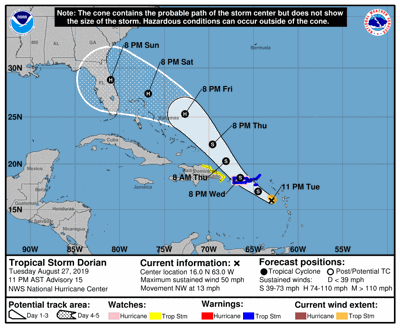
Hurricane Dorian’s projected path through Friday morning. Picture courtesy of NOAA and the National Weather Service. (Image via https://www.nhc.noaa.gov/) [Make sure you right click on the image to add a caption, change the image size to large, and include a source]
[Add a space before citing the featured image]
Featured image via pixabay.com [cite the featured image source at the end of the article. If you took your own picture, say “featured image via the author
Try to add relevant tags to your article, and don’t forget to do your weather snippet!
***BELOW IS OPTIONAL IF YOU WANT TO DO IT***
National Weekly Outlook
This is the first year we’re doing this article, so instructions are going to be a work in progress as we move through the semester.
Essentially, the goal is to give a broad overview of weather systems and impacts across the country for the upcoming week. Precipitation and temperature are two key parameters to focus on; if there’s any major events forecast to happen (blizzards, hurricanes, heat waves, etc), that’s a good thing to focus on.
A good place to start is with WPC forecast charts for the week. From there, you’ll get a general idea of the various fronts and pressure systems impacting the country. This will allow you to form the basis of your outlook.
Unlike the daily posts, these articles have no set format. The onus is on you to craft a well-thought out, organized article that touches on the major weather stories of the week. While this may require some more work, it gives you a chance to develop your writing and forecasting skills. An example of a national outlook can be found here: http://weather.umd.edu/2021/09/19/national-weekly-outlook/
Your editors are here to help! If you have any questions, feel free to reach out. Additionally, we don’t expect expert forecasts from you. This is meant to be a learning experience! If a mistake is made, a mistake is made. The editor on duty will check your forecasts both meteorologically and editorially, and will let you know of any major changes so that you can learn from them.